
Making space for creative expression supports me to reconnect with a sense of innate self dignity. But over and over I choose to put my attention elsewhere. Is my sense of self-worth so threatening that I feel compelled to spend my time, mental energy and life force in ways that negate dignity?
I’ve been stewing, brooding, bemoaning, stressing out and feeling incredibly stuck, fragmented and confused for the better part of this year. Writing and sharing that writing are supportive metabolic practices that nourish my emotional, mental and perhaps even physical health. Yet I’ve felt incapable of creating anything cohesive or complete or compelling with words. My soul feels battered around by time and the state of our world. As Kronos marches forward, more and more events happen and the number of ideas and experiences I wish to weave into these posts grows. Thoughts accumulate and overwhelm every corner of my mind and heart. Each time I come to the page, it’s as if the words — so alive in the moment they arose as thoughts — have perished in my hands, leaving just ash and bones behind.
Anyway… I’ve got all these half-digested pieces of writing sitting around clogging up the ol’ energetic intestines and the time has come to break ‘em down and push ‘em out into the proverbial loo of the world… even if they end up being the kind of hard poo’s that give a gal hemorrhoids. May the shit be nourishing:
Wanna hear a funny story?
One day — just an ordinary kind of day some years ago — I was walking up a little alleyway when I had the sudden realization that the purpose of being fully present is not, in fact, to feel “good” all the time! Now, at this point in my life I’d been meditating regularly for almost two decades and had spent a fair amount of time considering and practicing “being present.” I’d even led others in workshops and courses to cultivate qualities of mindful awareness. So it came as quite a surprise to me that I had never considered the idea that “the point” of being present is not to ultimately attain a sense of ongoing joy and blissful fulfillment. The point — if it can even be called that at all — is to notice and abide by all the things that might be arising in any given moment (which could include challenging emotions, strong physical sensations, compulsive behaviors, habitual thoughts, a wandering mind… or any number of other experiences). In other words, there is no endgame to being present. Shocking! Perhaps even more surprising was the fact that I’d been wholly unaware that I believed this until that moment. It’s as if I had been so conditioned to concentrate on the outcome or result of every aspect of life, that I could not see the simplicity of presence for presence’s sake. No transaction. No ultimate pay-out.
It’s also somewhat ironic that for me attaining “presence” equaled contentment, as I have long carried some disdain towards the idea of “being happy”. Maybe happiness seemed too simplistic, superficial or mundane to me. I even once scrawled out:
I am not really striving for happiness, though I do my best not to resist or deny joyful feelings, when they arise. But it is not a goal that I have. It feels like a racket. And I’m not tryna fuck with that.
Yet, a year ago when I contemplated my intentions for this Solstice to Solstice cycle, the word that strangely came forward was HAPPINESS. And I guess I just wanted to give it a go. Why not? When I shared my intention with Yeyo, he said something like: “That’s good to hear because sometimes I feel you are attached to sadness almost as an identity.”
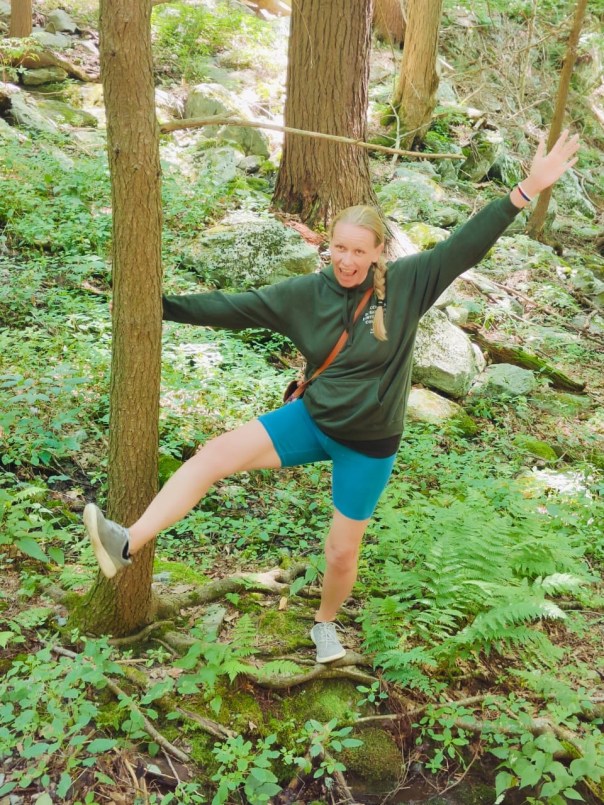
So I’ve been learning a little about happiness this year… and a little about sadness too. One of the things I see is how accepting what arises in my life, with attention and (eh-hem) presence can generate a kind of simple, authentic contentment. This is probably true because so often the emotions invoked by struggling against and almost violently wanting things to change or be different include anxiety, frustration, fear and anger. But this is not a saccharine, syrupy, smiley-face kind of happy. It’s a kind of peace that allows for all other feelings to also be present through the process.
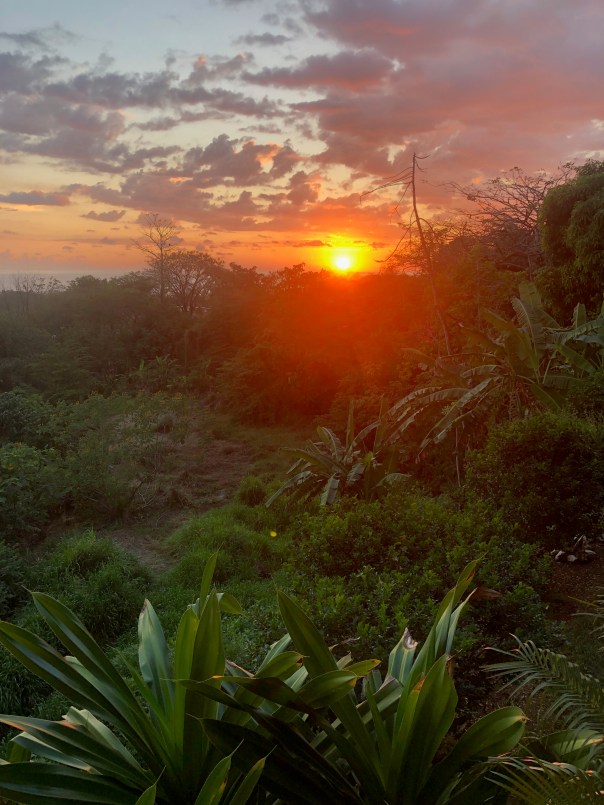
Most emotions are fleeting.* Shortly after setting my 2024 happiness intention, I spent ten powerful days weaving relationship with the plantas maestras in Costa Rica. The weather in the rainforest of Centroamérica is a vivid reminder about the way that experiences of all kinds come and go, come and go. There’s really no predicting how long one state or another might last, what might come next, and how extreme the change may be. One moment it can be beautiful and sunny and calm and, in mere minutes, the sky darkens, the temperature drops and torrents of rain pour from the clouds. Maybe the kind of “happiness” (or perhaps it’s called something else) I’m talking about comes from the practice of letting emotions in, feeling them fully, and then letting them go without attachment to a fixed story about what they mean.
This journey with happiness took an unusual turn in February when my massage therapist randomly said to me: “I invite you to try a 40-day ritual to explore your relationship with your sadness and inquire into why you’re so attached to it. Find out what role the sadness is playing in your life and see if you can release it and let something else enter in its place.” Wait! What? Where did that come from? We had never talked about sadness before and, quite honestly, sadness (like happiness) isn’t an emotion I really dwell upon much. I mean, yes, I definitely feel sadness but I had not considered it to be such a significant presence in my life that it would be “visible” to other people.
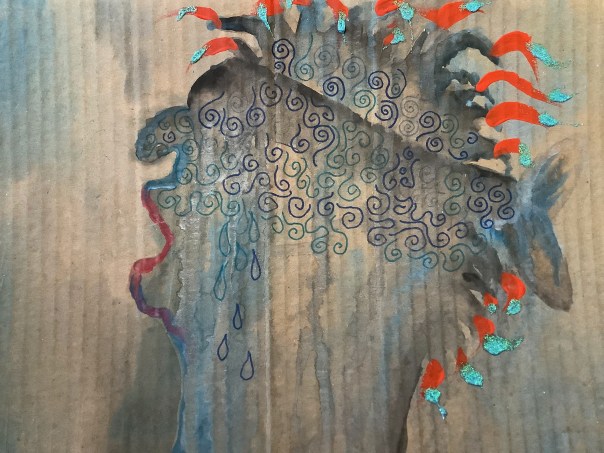
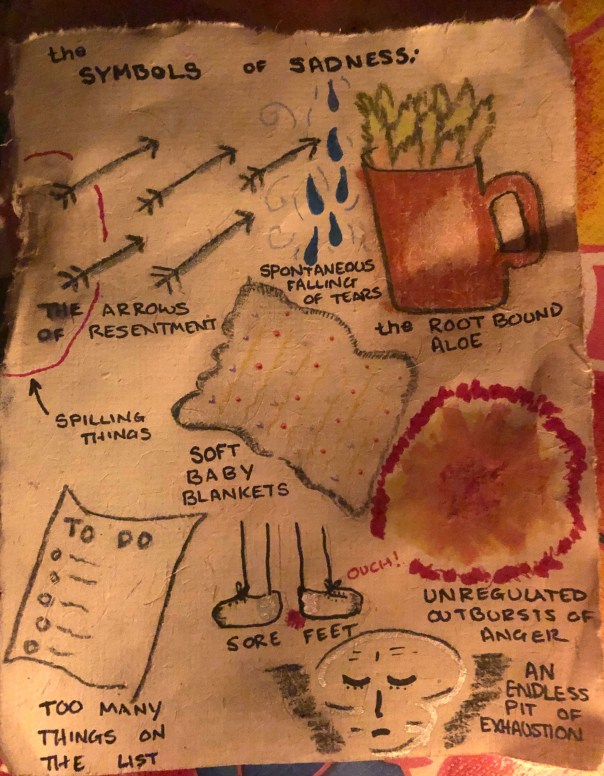
I accepted the invitation and on Ash Wednesday — exactly 40 days before my 50th birthday — I began exploring sadness and my entanglement with it. Each day, I did a small ritual: I built sadness an altar and created an ever-morphing painting of him; made little doodles of the “signs of sadness”; and mused about the relationship between sadness and anger. I wrote “notes to sadness,” like this one:
I thought you were my little secret, sadness. Maybe that’s why I don’t feel a lot of outward resonance or consciousness about feeling sad — it’s easier to hold on to you in a kind of amorphous manifestation rather than a “real” feeling… it reminds me of what Yeyo said to me about how I’m holding onto you, sadness, almost as an identity. So it would make sense, then, that I wouldn’t really be able to ‘see’ you, or even feel you because you are too close. In a way, from my perspective, you ARE me so I don’t recognize you as a passing outside entity.
What do you think? Do you feel like I’ve over-identified with you? Do you feel incarcerated? Pinned down? Nailed to my personality at this point? Do you feel like you’ve lost the autonomy to come and go at this point? If so, how does that feel? Maybe you don’t really feel like yourself any longer. And maybe I don’t either. I’m also noticing these red-hot barbs of resentment flying off the tips of you, sadness: an indignant flare that comes with a lot of anger and victimization. How do you feel about that? Is it annoying or frustrating to be decorated with ugly resentment? Does that make you feel less-than? Finally, sadness, what is it that you want? What are your deepest longings? I see your beauty and I can also see how maybe my dependence on you has become a crutch for me — a support or protection I may no longer need. What do you think-feel, sadness?
As I was nearing the end of my cuarentena ritual with sadness in March, I went to an event that shifted the course of the journey. I was invited to an Alive Conversation with Báyò Akómoláfé hosted by You’re Going to Die (yg2d), an organization bringing diverse communities creatively into conversations on grief, loss and our shared mortality (do check out their work… it is truly incredible). It was a conversation between my compadre Báyò and one of my new favorite people in the world, Ned Buskirk, co-founder of yg2d. Listening to the two of them, through laughter, storytelling and tears, I began to understand grief in a new way: not as an emotion that we “have” or experience, but as affect, as something beyond us, something which may “take” us in a way; something we likely have no agency over. Yes, it’s true that we may try to close ourselves off or to resist being taken. Many modern people have been well trained to do so. But grief-as-affect is not affected by our attempts to resist or ignore it. It was then and there that I realized that it is quite impossible to bid farewell to my sadness. Sadness will come and go in my life and I can allow myself to be taken by it or not, but I don’t get to decide whether it’s present or not. What I can choose to do without, however, is that sense of sadness as an identity. And that leads me to the final happiness-sadness revelation story of 2024…
This last fold in this tale is still unfolding as I’ve not had the chance to delve more deeply into its meaning since I heard the following ideas from our dear new friend, teacher and mentor, Dr. Erin Manning. We were discussing some of the concepts in her book The Minor Gesture over the summer when, somewhat out of the blue, she said, “Sad affect is a reactive force; it depletes the world. Joyful affect leaves a vestige in the world which creates more world; it is the ‘more-than.’ Joyful affect cannot be an individual feeling. Yet joy has nothing to do with happiness. Joy is ineffable.” Woah! As I look back on these notes now, I am left with a sidling sense that perhaps at the root of the challenges I found to cultivate more happiness or let go of sadness this year, is the idea that somehow these are “my” feelings. Much more than separate, individual emotions, these seem to be forces that transgress the person. I’m still not exactly sure what sad affect or joyful affect are but, with curiosity, I feel like I’m sensing my way into deeper, embodied understanding.
What I’m wondering, as we come full circle to Winter Solstice when I first set my intention of happiness, is if and how it’s possible to cultivate relations with these affective streams. How might we become porous to joyful affect and, in turn, perhaps co-conspire in the more-than, in the creating of more world? At first, I thought it might have something to do with my attitude or the approach I bring to living, and whether that is steeped with sadness or tinged with joy… but, once again, we have the little problem of that personal possessive pronoun. It isn’t so much about anything that I am doing as a subject acting on the world. The question, it seems, is around how “I” in blurring the boundaries of my personhood, might be a field where joyful affect could grow.
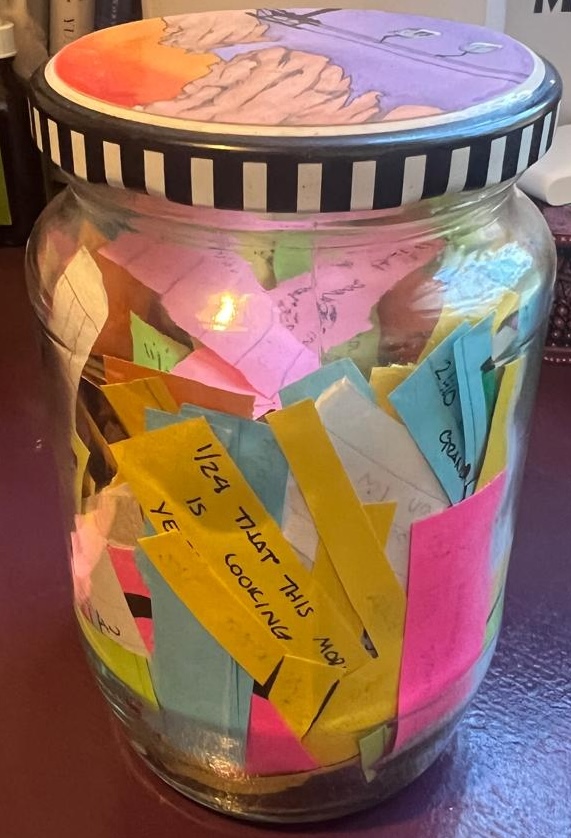
As for happiness, I’m still not even sure I know what it is, all these 361 days later. I started a happiness jar on January 1st; I tried to write down something that made me happy every day of the year. I often found myself unsure about whether or not I had felt happiness in a day… so I probably just wrote down a lot of things that I liked or that felt good or that I was grateful for. I think the main thing I learned is that I’m really not interested in going out searching for happiness. For, as Camus apparently said (according to Insight Timer),“You will never be happy if you continue to search for what happiness consists of. You will never live if you are looking for the meaning of life.” This next cycle, I’m more interested in resting and listening and becoming porous than seeking anything at all.
*A teacher of mine once shared that, on average, an emotion can only last something like 30 seconds.
 In the Name of Rafa
That is a lot to take in. Oddly. this e-mail sender name was Daybell, Richard. I get his news letter. They often ask about you. I’ll check out the YG2D podcast. Looks interesting. I’m anxious to find out what our next 4 years will bring. Maybe we won’t last that long.?? I hope you and Yeyo have a joyous Navidad, and feliz Ano 2025. Will contain joy and sorrow, I’m sure. Glad you are my wonderful, and amazing daughter. Love you, CD
>
LikeLike